
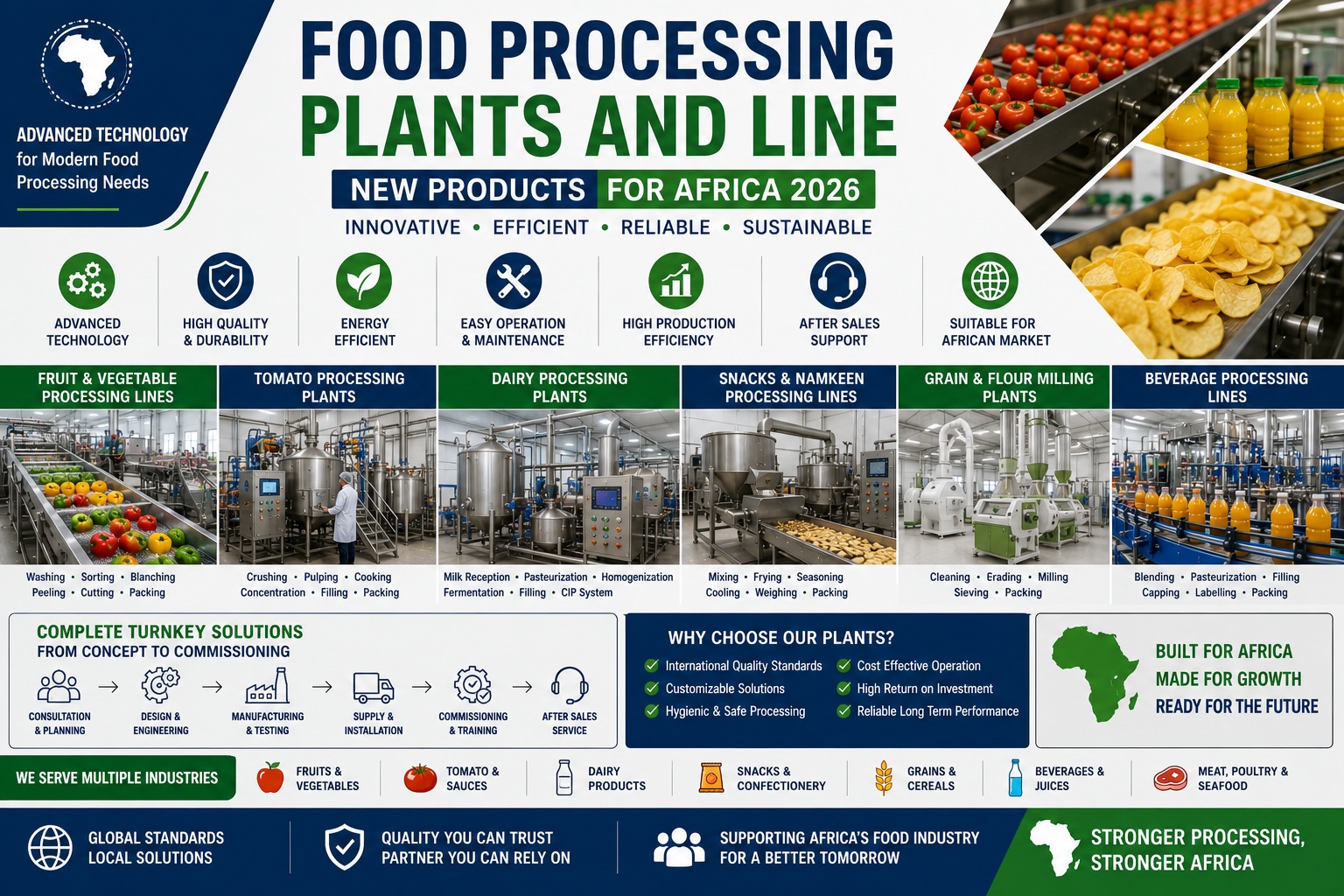
Why Africa's Food Processing Boom Is a Machinery Problem Before It Is a Food Problem
There is a statistic that gets repeated at every African agribusiness conference: the continent loses somewhere between 30% and 40% of what it grows before that harvest ever reaches a consumer. It is quoted so often that it has stopped meaning anything. But if you sit inside the problem rather than beside it, the number resolves into something very specific and very fixable — a mango in Ivory Coast that had no pulper within 40 kilometres, a tomato in Kano that had no paste line within a day's drive, a cassava harvest in Nakuru that arrived at a mill sized for a tenth of the volume.
Post-harvest loss in Africa is not primarily an agronomy failure. It is a machinery gap. And the gap is closing right now, faster than most exporters have adjusted to.
We manufacture and export turnkey food processing plants and complete production lines to precisely this moment. This article is written for the person actually making the buying decision — the industrial group in Lagos evaluating a 5 TPD tomato paste line, the cooperative federation in Addis Ababa preparing a tender, the distributor in Accra who wants to hold stock of small-scale units. It covers what changes when a food line is destined for Africa rather than Europe, because a great deal changes.
The Ten Markets, and What Each One Actually Buys
Bulk supply strategy fails when it treats "Africa" as one buyer. It isn't. Ten distinct procurement personalities dominate our order book:
Nigeria is the continent's largest single opportunity and its most demanding. Tomato paste, cassava (garri and high-quality cassava flour), palm oil, rice milling, and increasingly fruit juice. Nigerian buyers negotiate hard on landed cost, insist on SONCAP certification, and — this matters — buy machinery that can run on generator power because grid supply is unreliable. A line specified without generator-tolerant motor starting characteristics will be returned as faulty when it is merely mis-specified.
Egypt buys sophisticated. Date processing, olive oil, frozen vegetable lines, and a substantial export-oriented packaging segment. Egyptian importers navigate GOEIC registration under Decree 43, which requires the manufacturer to be pre-registered — not the trader. Exporters who have not done this paperwork simply cannot serve Egypt, which is why the market is less contested than its size suggests.
Kenya is East Africa's processing hub — dairy, tea, avocado oil, and a fast-growing snack sector. PVoC inspection through KEBS-appointed agencies is mandatory. Kenyan buyers are unusually technical and will ask for material certificates on food-contact surfaces.
Ethiopia has enormous volume potential in coffee, sesame, teff, and edible oil, plus government-backed industrial parks actively importing complete lines. The constraint is foreign exchange allocation, which shapes payment structures more than price does.
Ghana focuses on cocoa secondary processing, cassava, palm oil, and shea butter. Government policy actively pushes value addition before export, which converts directly into machinery demand.
Tanzania buys sunflower oil expelling, cashew processing, and maize milling — often through cooperative and district-level purchases where multiple identical mid-size units are ordered together. Ideal bulk supply structure.
South Africa is a mature, standards-heavy market. Buyers expect CE-equivalent documentation, SANS compliance, and will audit your welding and hygienic design. Winning here is slow but the reference value is disproportionate.
Morocco processes citrus, olives, argan, and seafood, with a strong export orientation to Europe that forces EU-grade hygiene standards on the equipment.
Algeria is heavily tender-driven with strong local-content policy. Date, dairy, and semolina processing dominate. Contracts are large, documentation is exhaustive, and the buyer is often a state entity.
Côte d'Ivoire is the cocoa and cashew story, with a national policy push toward in-country grinding and processing that has created sustained demand for mid-scale lines.
What Actually Has to Change in the Machine
This is where most exporters lose credibility, and where a genuine manufacturer separates itself from a trading house with a catalogue.
Electrical specification. Nearly all of these markets run 380–415V, three-phase, 50Hz. That is straightforward. What is not straightforward is that the effective supply frequently sags to 340V or spikes above 440V, and much of the time the line is running off a diesel genset with poor transient response. We specify oversized motor frames, phase-failure and under-voltage protection as standard rather than optional, and soft starters on any drive above 7.5 kW so that starting current doesn't collapse the genset. This single specification decision prevents the majority of warranty claims we would otherwise see.
Thermal derating. A control panel rated for 40°C ambient will nuisance-trip in a Sahelian processing hall where the shade temperature is 45°C and the panel sits beside a steam line. We derate cabinets, upsize ventilation, and where the application justifies it, specify panel air conditioning. Cheap to do at manufacture; expensive to retrofit in Kaduna.
Dust and washdown ingress. Harmattan dust in West Africa is finer and more pervasive than most European engineers imagine. IP55 as a floor specification, IP65 on anything in the wash-down zone, and sealed bearing housings rather than open ones.
Water quality tolerance. Boilers and CIP systems fed with hard, high-TDS borehole water will scale rapidly. We supply lines with integrated pre-treatment sizing rather than assuming municipal-quality feed — a point where our Water Treatment Solutions division is routinely specified into the same project.
Maintainability over sophistication. The most common specification error in African food plant procurement is over-automation. A line with a proprietary HMI, sealed servo drives and a manufacturer-locked PLC will run beautifully for eighteen months and then stop for four weeks waiting on a part. We deliberately build around widely available drive brands, standard bearings and metric fasteners, and we ship a critical-spares kit with every plant. Uptime beats elegance.
Compliance: The Real Gatekeeper
For bulk orders, conformity documentation kills more deals than price does.
- Nigeria — SONCAP, issued against a Product Certificate from an accredited agency, obtained before shipment. Goods arriving without it face demurrage and potential re-export.
- Kenya — PVoC Certificate of Conformity, inspection at country of origin.
- Tanzania — TBS PVoC. Uganda — UNBS PVoC.
- Egypt — GOEIC manufacturer registration under Decree 43, plus standard import documentation.
- Ghana — G-CAP conformity assessment.
- Algeria — pre-shipment inspection and Arabic-language technical documentation.
- South Africa — SANS/NRCS requirements depending on equipment class.
We hold pre-registration where it is required and manage inspection scheduling as part of the order, not as an afterthought handed to the buyer.
Logistics and Payment Structures for Bulk Orders
Complete lines ship as a mix of 20ft, 40ft and occasionally flat-rack or breakbulk consignments for large vessels and tanks. Practical routing: Apapa and Tin Can for Nigeria (with Lekki increasingly viable), Tema for Ghana, Abidjan for Côte d'Ivoire, Mombasa for Kenya and onward corridor to Uganda and Rwanda, Dar es Salaam for Tanzania and Zambia, Djibouti for Ethiopia, Durban for South Africa, Alexandria and Damietta for Egypt, Casablanca and Tanger Med for Morocco.
On payment: we work with irrevocable LC at sight or usance through a confirming bank, partial advance with balance against shipping documents, and for multilateral or donor-funded projects, structures aligned to World Bank, AfDB and IFAD disbursement rules. For markets under forex pressure, staged shipment against staged LC amendment keeps projects moving where a single large LC would stall.
Commissioning, Training and the Second Order
A food line is not delivered when it lands. We treat commissioning as part of manufacture: engineer deployment for installation and trial production, operator and maintenance training in English, French or Arabic, documented SOPs, and a defined spares list with part numbers your local fabricator can cross-reference.
This is not customer service theatre. It is commercial strategy. Bulk supply relationships in Africa are built on the second and third order, and the second order only comes when the first plant is still running at rated output two years later.
Frequently Asked Questions
Do you supply complete turnkey lines or individual machines? Both. We supply single machines for capacity expansion and complete turnkey lines including layout design, utilities specification, installation and commissioning.
What capacities do you manufacture? From small-scale units suitable for cooperatives and SMEs through to industrial plants. Capacity is specified against your raw material availability and shift pattern, not against a catalogue number.
Can you support tender documentation? Yes. We provide technical compliance sheets, manufacturer's authorisation letters, past-performance references and certified drawings for public tenders across our target markets.
What is a typical lead time for a complete line? Standard configurations ship in weeks; fully customised turnkey plants are quoted case by case. Sea transit and conformity inspection are scheduled into the delivery programme, not added to it.
Do you appoint exclusive country distributors? Yes, for partners able to hold stock, maintain a spares inventory and provide first-line service.
CONTACT US: Share your raw material, target throughput and destination port. We will return a line layout, utility requirement, landed-cost indication and conformity plan.
